
Yesterday CARTOONISTS RIGHTS announced the death of our founder, Dr. Robert Russell. In the winter of 2017, he had an interview with Dr. John Lent – another stalwart of our organization who passed earlier this year – for the International Journal of Comic Art (IJOCA). We present an extract, wherein he explains the path that led him to begin working on behalf of cartoonists worldwide.
This will be the first in a series of posts in the days ahead, as we receive more tributes from former friends, colleagues, and clients.
NB – in his latter years Russell made use of speech-to-text software. The following has been taken from his original files and edited for clarity.
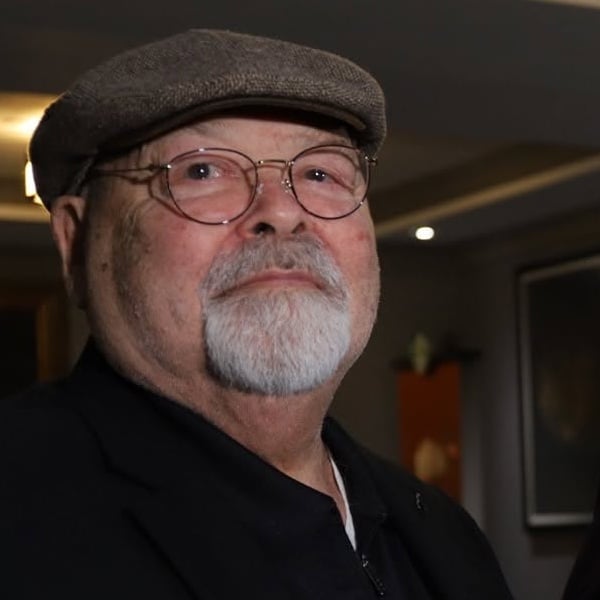
“I didn’t do it because I’m a cartoonist, or out of some sense of humanity, but the very practical reason that they (cartoonists) are the most cost-effective and powerful social change agents in any culture!” – Robert “Bro” Russell, 1942-2026
“I’ve never been a cartoonist. While my undergraduate degree is in fine arts – painting and sculpture – and I still do a bit of drawing from time to time, my professional life has been in the field of international community development. During my productive years, I don’t think I’ve worked more than two-out-of-forty in the United States. I’ve always worked as a medium to long-term consultant, usually being paid by some of the better-known international community development agencies, and sometimes directly with United States’ Agency for International Development (USAID) in East, West and North Africa, the Middle East, India, and Sri Lanka.
I eventually specialized in helping local, indigenous nongovernmental organizations find their way in the world by helping to build their board of directors, understanding more about international development in the world of donor agencies, and especially finding more efficient and productive ways to serve what we commonly call the grassroots communities in rural areas. I’ve overseen the development of healthcare systems, family-planning organizations, farmers and farm marketing groups, and I’ve also been the head of a number of national level consortia organizations. These are organizations of organizations.
In the development business we are always taught: next year, less money; next year, more productivity too. We learn the lesson of seeing an environment in terms of cost-effective ways of doing things more efficiently yet more cheaply. The donors are always telling us, next year instead of building five bridges for $10,000, you’ll have to build ten bridges for $5,000 if you want to make the cut. Efficiencies of scale.
As a former art student with a sense of humor, while working around Africa, South Asia, and the Middle East I always pay very close attention to the local political cartoonist(s). In every country I visited I made it a point to make friends with a number of them. I would invite them out to lunch, talk to them about their artwork, how they got into the business… We’d always look at a portfolio of their work, and for the length of time I was in that country we would get together and talk with each other as often as was practical.
I didn’t really realize it at the time, but I was building up an inventory of information and cultural background on the typical political cartoonists in these developing countries. There eventually emerged a profile. They were the guys (and the women!) who were kicked out of school because they were drawing pictures of the teacher instead of taking notes. For the most part they did not have the same educational level as the print journalists in the local newspapers. If one of the top-level personnel was being paid enough to get a company car, the cartoonist was lucky to have enough money to be able to afford a bicycle.
They were rarely on staff or under contract. They would come into the office in the morning and turn in a cartoon, get their four or five dollars pay for it, and that was it. Absolutely no job security, they were at the low end of the totem pole of editorial room culture. But one thing I did learn, is that inevitably the best of them where the ‘Hidden Heroes’ of the journalism world in their own communities.
When I was working in Nairobi, Kenya, I happened to mention to my secretary that I was going to have lunch with GADO, cartoonist for The Daily Nation newspaper. Her face went slack and her jaw simply dropped open. Very tentatively, almost religiously, she gathered up her courage and asked ‘what do you you mean, you’re having lunch with Gado?’ It was as if I had said I was having lunch with Michael Jackson and The Pope. She went on to tell me that absolutely everybody in town read him every day, and she closed by saying ‘he says things that we are all afraid to’.
About a year later I was fresh off the boat working on a project in Uganda, and I was having to break the ice in a meeting with the political officer at the US Embassy in Kampala, just to ask questions about the lay of the land, the current politics and security situations around the country. I casually mentioned a cartoon that I have seen that morning drawn by MR. RAS in the nation’s leading newspaper. She had a more subdued but similar response to my secretary in Kenya. She then smiled and said ‘you really catch on fast.’ And I asked her why, she said – and here I’m paraphrasing because I can’t remember so far back, word for word – when we go to charm school to learn how to be diplomats we are taught that the first thing you do in the morning before you get coffee or open your emails, before you read the cables or any of the editorials in the newspaper, before you do anything, you read all the day’s political cartoons. Then, you will know what absolutely everybody is talking about in town this morning.
The proverbial light-bulb went off in my head: who in any culture can you pay less, who has more influence on people’s opinions? In the developing countries where I was working, the most cost-effective social change agent was the lowly political cartoonist! The preachers might have their pulpits, but they have their multi-million dollar structures as well. The politicians might have their soapboxes, but they also have multi billion-dollar armies and air forces. Coca-Cola might be able to build a factory and employ five hundred thousand people, but that will also cost millions of dollars.
Who can you pay five dollars for a cartoon that in the right place and the right time, and from the pen of a brave person, could possibly bring down a government?
Well – cartoons don’t very often bring down governments, but they do often start the processes. That’s why today so many cartoonists wind up in prison, in the courts, killed, beaten, threatened, intimidated; or in the most common scenario have their lives and livelihoods taken away from them by the absolute constant grinding away of their resources, their mental health, their families’ loyalty, by some arm of the state. Your own country, to which you are usually 100% faithful, loyal, and love deeply.
At a point about twenty-five years ago as I was beginning to think about retirement. I decided that I would spend the rest of my life helping political cartoonists who were in trouble because of their cartoons. I didn’t do it because I’m a cartoonist, or out of some sense of humanity, but the very practical reason that they are the most cost-effective and powerful social change agents in any culture!
Along with my years of associating with them, I also learned that they rarely if ever belong to any of the major human rights or free-speech agencies either internationally, or even domestically. I would ask them whether they belong to the local journalism association. Usually they said no, that they weren’t really considered true journalists by the local community, and anyway membership of those professional associations is always too much for them to pay.
When I was working in Sri Lanka in 1989, during the height of two different wars that the government was waging, I met a cartoonist, JIFFRY YOONUS who had been beaten, stabbed, his car trashed, family terrorized, house ransacked by the goons of the current president, all because of a series of cartoons he had drawn about the president’s political and financial corruption.
I met him in the copy-room of his newspaper, where he felt he might be safe as the goons wouldn’t actually attack or invade a newspaper. His head was bandages and his arm was in a sling. He had stitches all over his body where they’d poked him with knives and he was clearly so traumatized he could hardly think straight. I asked him what he wanted from the international community. I expected some macro-level answer, ‘have the US ambassador talk to the president, report the whole thing to the United Nations, start a sponsored international appeal in my favor to get them to leave my family alone’, I was thinking. But he simply said:
If they kill me please make sure my children have shoes for their feet so that they can go to school. Make sure my wife will be taken care of. If they put me back in the hospital, please make sure I get a decent doctor to look after me.
It was so simple. Nothing huge, nothing international, nothing dramatic, just simply: please take care of my family. Well Jiffry and I started at that moment the Cartoonists Relief Network, the name by which we were known in our infancy for about the first five or six years of our operations, from about 1990 onward.”
[Cartoonists Rights Network International was formally incorporated as a non-profit in the Commonwealth of Virginia at the end of 1999.]
• The full interview ran in IJOCA, Vol. 20, No. 1 – Spring/Summer 2018; visit their blog. •
UPDATE: the Russell family have posted an obituary at Legacy.com however they have requested that well-wishers send no flowers and instead make a donation to CARTOONISTS RIGHTS.